History of City Park Greenhouse in Reading,pa
Whether they were devastated by state of war, natural disaster, or were victims of their ain success, many once-bang-up cities take been lost and never plant. While nosotros may never really know the stories of many aboriginal and lost cities, some have been rediscovered many centuries later — often by accident.
Here, we volition take a look at 31 such lost, and forgotten, ancient cities, and discover, as all-time we can ascertain, just why they were wiped from the map.
1. Helike: an ancient Greek urban center that sank

Helike could very well exist the existent Atlantis. According to Greek legend, Helike was destroyed by an enraged and vengeful Poseidonfor the Helikonians' refusal to requite their renowned statue of the sea god, or fifty-fifty a re-create of it, to Ionian Greek colonists in Asia Small (modern Turkey).
Based on accounts of ancient sources and on contempo archaeology, it is believed that an earthquake in 373 BCE caused the groundbelow the entire urban center to liquefy. A tsunami thenengulfed the sunken urban center. According to ancient sources, the city disappeared in the infinite of only an 60 minutes or ii and there were no survivors.
Helike was rediscovered in the 1980s by two archaeologists who had been searching for it for over a decade. It has since been partially excavated.
2. Skara Brae was uncovered during a storm

Skara Brae is 1 of United kingdom of great britain and northern ireland'south best-preserved Stone Age settlements. Although information technology might be a stretch to call it a city, it is certainly a very interesting site.
It was lost to the ages under a sand dune; a neat storm in 1850 re-exposed the site.
The buildings are relatively well preserved given their age considering they were protected for thousands of years under the sand.
Radiocarbon dating seems to indicate that the site was occupied betwixt 3200 BC and 2200 BC. It was abandoned due to a combination of encroaching sand dunes and the inhabitant's own detritus.
3. Krishna's Sacred City ofDvārakā is another famous lost city

Dvārakā is a recently rediscovered Hindu, Jainist, and Buddhist sacred metropolis. It forms 1 of the so-chosen Sapta Puri, or seven sacred cities, of Hinduism as was the legendary home of the God Krishna.
According to legend, the city was destroyed during a huge battle between Krishna and King Salva. The urban center was annihilated by blasts of energy never to be seen again.
Many millennia later, during the 1980s, Indian scientists found the ruins of a metropolis near to where legend described it to exist. It is now thought that the city could have been congenital effectually 9,000 years ago.
If true this would make information technology 1 of the oldest cities on Earth.
4. Caral is the most ancient city in the Americas

Caral, or Caral-Chupacigarro, was once a long-forgotten aboriginal settlement in the Supe Valley, Peru. It is located 124 miles (200 km) north of Lima.
Declared as a UNESCO World Heritage Site in 2009, it is one of the most ancient cities in the Americas. It is thought to have been inhabited between 2600 BC and 2000 BC.
With an estimated three,000 inhabitants at its height, it would have been one of the largest cities of the Caral (or Norte Chico) civilization.
It was rediscovered in 1948 by Paul Kosok and his team.
5. Timgad was one time a thriving Roman colony

Timgad, orColonia Marciana Ulpia Traiana Thamugadi to the Romans,was once a thriving Roman colony in Algeria. It was founded by Emperor Trajan former around 100 Advert.
The one time-lost city is located in the Aures Mountains of the region and was named in honor of Trajan's female parent Marcia. The city was abandoned after being sacked by the Vandals in the fifth century and so the Berbers in the seventh century.
It was afterward buried by the sands of the Sahara until its rediscovery and digging.
Today, information technology is noted for being a great case of the Roman grid arrangement town planning. It became a UNESCO World Heritage Site in 1982.
vi. Bully Zimbabwe was once the center of the Zimbabwean Kingdom
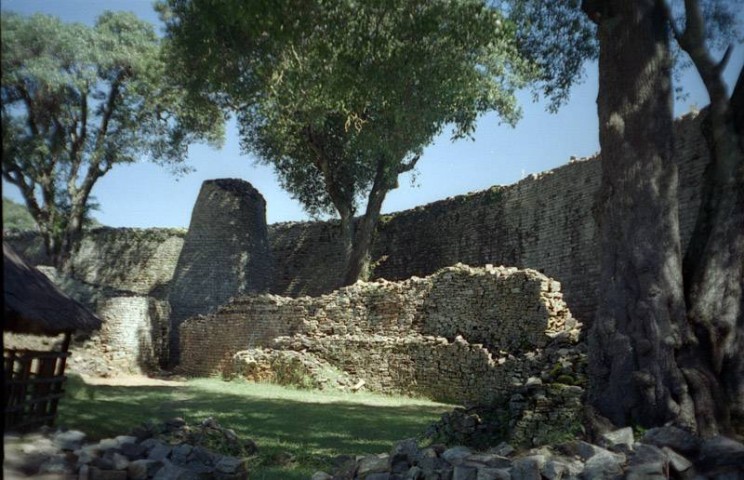
Great Zimbabwe is an abandoned medieval city located in the Southward Eastern hills of Republic of zimbabwe, near the mod town of Masvingo. The metropolis was the capital of the Kingdom of Republic of zimbabwe during their Late Fe Age.
Information technology was built by the indigenous Bantu people betwixt the 11th and 15th centuries and was occupied for about 300 years. Around xviii,000 inhabitants are thought to have lived in the city at its height.
Great Zimbabwe was abandoned after a menstruation of decline due to issues with merchandise, political instability, and ultimately famine and water shortages.
The first documented and confirmed records of its rediscovery was in 1871.
7. Hattusa was the uppercase of the once all-powerful Hittite Empire

The Hittite capital of Hattusa near mod Boğazkale, Turkey, was lost to ravages of time for millennia. The metropolis was sacked and the Hittite Empire collapsed during the so-called Statuary-Age plummet effectually 1200 BC.
This catastrophic result is, past some, idea to have begun with an invasion of the and so-called "Sea Peoples" that also attacked and raided cities of the ancient Egyptians at around the same time. Just it is probable thatthe metropolis was finally destroyed by the neighboring Kashka, a bitter enemy of several centuries' standing.
The urban center was subsequently abased and forgotten. It is thought to have once housed around 45,000 people during its acme.
Hattusa was rediscovered in the 20th century by High german archeologists. The squad found a literal treasure trove of clay tablets with writings ranging from legal codes to literature.
8. Taxila was captured by Darius and later surrendered to Alexander the Nifty

Taxila, aka Takshashila, is a rediscovered ancient city in northern Pakistan. The ruins are situated well-nigh mod Taxila in the Punjab region of Pakistan roughly 35 km (22 miles) NW of Rawalpindi.
The aboriginal city was captured by the Persian male monarch, Darius the Bully in 518 BC and afterward surrendered to Alexander the Peachy. Information technology would become through a menses of rule by various other conquerors before becoming an important Buddhist site.
Information technology is idea to have been founded effectually grand BC; it would go an of import city in the region attributable to its position on East-West trade routes.
It would later undergo a menstruation of reject until information technology was finally destroyed by the Huns in the 5th century Ad. The metropolis was rediscovered by Alexander Cunningham in the mid-19th century.
9. Sigiriya sits on a behemothic rock outcrop

Sigiriya was a 5th century Advertising city founded in Sri Lanka on top of a rock outcrop 656 feet (200 meters) tall. It was built by Rex Kasyapa and could simply be accessed through the mouth of huge brick and plaster lion entrance.
According to Sri Lankan legend, Kasyapa(ruled 477 – 495 CE)chose the site for his new capital and promptly built his palace on the rocky outcrop. The sides of which were so decorated with colorful frescoes.
Sigiriya was not occupied for long as it was abandoned subsequently the king's death. Information technology was a Buddhist monastery until the 14th century and is today a UNESCO World Heritage site.
The site was rediscovered by archaeologists in 1831.
x. Gordium: King Midas' bully capital

Gordium, orGórdion (pronounced Gor-di-yon) in Turkish, was the capital urban center of the ancient Phrygian Empire. Located in Asia Modest, it is roughly 47 miles (75 km) SW of Ankara.
The city lies on what was one time the ancient road betwixt Lydia and Assyria that crossed the Sangarius River. Gordium's most famous ruler was the quasi-legendary King Midas.
Gordium was sacked by the Cimmerians and subsequently abandoned in around 800 BCE merely was rebuilt by the Persians.
Alexander the Great is said to have visited the city and solved the puzzle of the Gordian Knot, which said that whoever could loosen the knot would rule Asia — Alexander is said to have solved this trouble past merely cutting the knot.
The forgotten city was rediscovered and excavated in 1900 by Gustav and Alfred Korte, and after by the Pennsylvanian Museum, betwixt 1950 and 1973.
11. Leptis Magna was cached past the sands of time

Leptis Magna was the birthplace of Emperor Septimius Severus and once a slap-up Roman metropolis, located in what is now Libya. Information technology was originally founded as a Berber and Punic settlement, but was greatly expanded by Emperor Severus during his reign.
The famed Legio III Augusta was stationed in the city until its dissolution in 238 Advertising. The city would then undergo a menstruation of decline as the Roman Empire roughshod to the Vandals in 439 Advertizing.
It was later on reunited with the Eastern Empire, but was constantly plagued past Berber raids and finally fell to a Muslim invasion in 647 Advertisement.
Once abandoned, the city was consumed by the Libyan sands until its rediscovery in the 19th century.
12. Mohenjo-Daro was lost for almost ii millennia

Source: Benny Lin/Flickr
Mohenjo-Daro, roughly meaning 'Mound of the Dead Men', is one of the worlds oldest urban settlements. It was founded and built around 2600-2500 BC, in nowadays-mean solar day Pakistan.
Studies accept shown that it was abandoned former in the 19th century BC, equally the civilization declined.
The city would be forgotten for almost 2 millennia, before being rediscovered in the 1920s. It was made a UNESCO World Heritage site in 1980.
13. Vinland: where the Vikings supposedly settled in North America

Vinland, Winland, or Vineland was the name given to an area of Due north America plainly settled by Norse Vikings in effectually chiliad Advertising. Once idea to exist a myth, a Viking settlement was really found in Fifty'Anse aux Meadows in Newfoundland in the 1960'due south.
Earlier this discovery, the story was widely dismissed every bit pure fantasy. Interestingly, the story also told of how the adventurers fought the locals, who they calledSkraelingar.
These people, it was said, dressed in white dress and lived in caves and holes. When they attacked, they carried long poles and allow out terrifying battle cries. There is no evidence for this story, merely it does announced that the Viking settlement atFifty'Anse Aux Meadows was used as a Viking encampment for a short time, mayhap every bit a base for further exploration or to gather supplies.
14. Heracleion was plant accidentally past divers

Heracleion, also known as Thonis to the Egyptians, was an ancient metropolis located near the mouth of the Nile. It is roughly 20 miles (32 km) Northward-East of Alexandria.
According to Greek legend, this was the city whereHeracles took his first steps into Africa. It was said to be the place where Paris hid Helen before the onset of the Trojan War.
Autonomously from appearing in fable, the metropolis was nowhere to be found, and for good reason. Just over 2000 years ago, it was likely hitting past an earthquake and/or tsunami and was drowned.
It was rediscovered by divers in the early 2000s by a complete blow.
15. Neapolis was decimated by a tsunami one,700 years ago

The ancient city ofNeapolis was lost for most i,700 years after it was devastated by a tsunami. At the time of the tsunami, information technology was a thriving Roman town, but information technology was lost for centuries until it was found in 2020, North East of Tunisia.
Amidst the usual detritus from an ancient city, the squad plant evidence of large tanks used to make garum. This was a popular fish sauce of the flow consumed by Greeks and Romans in vast quantities.
Little else is known of the boondocks's history, except that it was captured by the Romans during the Third Punic Wars.
sixteen. Herculaneum: Pompeii's bottom-known cousin

Herculaneum was an affluent Roman Town that was destroyed at the aforementioned fourth dimension as Pompeii in 79 AD. Its ruins were buried by pyroclastic flows preserving the buildings (and its inhabitants) until information technology was rediscovered in the 1700's.
Proper excavations didn't occur until the 20th century.
It is renowned for being i of the very few sites that preserve the original splendor of an aboriginal Roman city. Big amounts of the original construction timbers take also survived to the present solar day.
Current research indicates that Herculaneum was primarily occupied by the very wealthy amongst Roman guild.
17.Palenque was eaten by the jungle

Palenque, aka Lakamha or "Big Water", was a Mayan city-state in Southern Mexico. Evidence suggests that it was a flourishing place in the seventh century AD.
Archaeological studies indicate that the site had been occupied betwixt around 226 BC to well-nigh 800 AD. Afterward this time, it went through a period of turn down and the site was eventually absorbed by the jungle.
It was rediscovered by Europeans in the belatedly 1700's and has since become i of the virtually studied Mayan sites.
18. Cliff Palace is the largest cliff domicile in N America

The Cliff Palace in Mesa Verde National Park is the largest cliff settlement in North America. It was once the dwelling of the ancient Palaeo-Indian Anasazi peoples, otherwise known as the Bequeathed Puebloans.
Studies indicate that the site was occupied from 1190 AD to about 1260 AD. It appears that the site was abandoned effectually 1300 AD.
Debates rage as to why the occupants left the settlement, simply climate change seems to be the leading culprit. The Cliff Palace was rediscovered in 1888 by Richard Wetherill and Charlie Mason whilst they searched for stray cattle.
19.Hvalsey was a Viking settlement on Greenland

Hvalsey, aka 'Whale Island', is a long-lost Viking settlement located nearQaqortoq, Greenland. Information technology is, to engagement, the largest and best-preserved instance of Norse ruins in what is known every bit the Eastern Settlement.
It was settled around 1000 Advertisement by Norse farmers who were idea to have arrived from Iceland. The site was probably home to well-nigh four,000 people during its peak.
The Western Settlement would be abased in the 14th century, with Eastern Settlement lasting a little longer before likewise being abandoned.
Records exist of a wedding being held in the settlement's church in 1408. This was the last tape of any abode of the area.
The site was rediscovered in 1721 by a Danish missionary.
20. Tiwanaku was once a cultural center in Republic of bolivia

Tiwanaku was a pre-Columbian settlement that can exist found in Western Bolivia. Its original proper noun has been lost to the ages, as its inhabitants did not accept a written language.
Tiwanaku is thought to accept been inhabited by peoples who probably spoke the Puquina linguistic communication. It is thought that the site was inhabited from as early as 1500 BC.
The city reached its height between 300 BC and 300 Advert when it appears to take been a cultural center. Around chiliad AD, the city roughshod into decline and was abandoned, as climatic changes forced the inhabitants to leave.
It was first recorded by Europeans in 1549, by Spanish conquistador Pedro Leon, whilst he was searching for the Inca capital letter.
21.Akrotiri might also be the inspiration for the legend of Atlantis

Akrotiri was a Minoan Bronze Age settlement on the island of Santorini. It was abandoned and buried during a volcanic eruption effectually 1620 BC. Volcanic ash and other deposits engulfed the aboriginal metropolis, preserving many of its buildings and fine frescoes. Non to mention a plethora of artworks and other objects.
Since its rediscovery in the mid-1800's it has been postulated that this might be the inspiration for the legend of Atlantis. The site was finally excavated in 1967.
22.Sukhothai was the uppercase of the curt-lived Tai Empire

Sukhothai was once the capital urban center of the Sukhothai Empire. The proper noun roughly translates to "dawn of happiness" and the empire emerged in the 13th century AD post-obit a revolt against the Central khmer Empire.
Sukhothai became the beginning united and contained Tai land. The site is nearly 265 miles (427 km) north of Bangkok and stood equally the empire's capital for 140 years. At its height, it is thought to accept had around lxxx,000 occupants. Its power and influence began to wane when Ayutthaya, a rival Tai dynasty, was formed.
Sukhothai was subsequently captured in 1438 and became an obscure town in theAyutthaya kingdom. Information technology was after abandoned in the 16th century.
Information technology was later rediscovered past the world and has since been designated a UNESCO World Heritage site in 1991.
23. Chan Chan was the largest pre-Columbian city

Chan Chan was the largest of the pre-Columbian era cities in South America. It is now an active archaeological site roughly 3 miles (5 km) west of Trujillo, Peru.
The metropolis used to be the capital of the Chimor Empire from 900 to 1470 AD. Chimor was eventually defeated and absorbed into the larger, more than aggressive Incan Empire as a vassal land.
Chan Chan fell into reject when Spanish invaders built the nearby metropolis of Trujillo. It would afterwards be continuously looted past Spaniards until the city was completely abased and forgotten.
Archaeological excavations began in 1969 and continue to this day.
24.Ürgenç was sacked by Genghis Khan

Ürgenç, or Urgench, is an ancient and abandoned former capital of the Khwarezm Empire, once a part of the larger Achaemenid Empire. Information technology was occupied right up to the 1700s until information technology was finally abandoned.
It has remained practically untouched ever since.
The city'due south golden historic period was between the 12th and 13th centuries. It was sacked by Genghis Khan in 1221 and the population was enslaved or massacred.
Urgench was partially rebuilt and reoccupied for a time before the new settlement of Kunya-Urgench was built.
25.Calakmul had an intense rivalry with Tikal

Calakmul, or Kalakmul, was a Mayan metropolis at present located in the Mexican state of Campeche. It was lost to the ages deep within the jungles of the Peten Basin until its rediscovery in 1931.
Information technology used to be one of the about powerful ancient cities inside the Mayan lowlands.
Throughout virtually of its history, the city had an intense rivalry with the neighboring Tikal metropolis to the south. This rivalry spilled over into war, with Calakmul losing a decisive boxing in 695 AD.
Both cities would ultimately fall into obscurity and were abased with the collapse of the Mayan civilization.
26. Palmyra was once a very wealthy merchant metropolis

Palmyra or "City of Palm Copse" used to be an influential and wealthy city located in nowadays-day Syrian arab republic. Some archaeological finds advise it may accept Neolithic origins, but information technology was showtime mentioned in the 2d century BC.
It was eventually conquered by diverse external powers, including the Romans in the 1st century Advertizing.
The Palmyrenes were renowned and successful merchants who established colonies all along the silk route. After a brief rebellion, the city was leveled by Emperor Aurelian and partially rebuilt past Diocletian.
It was later captured by Muslim Arab invaders in 634 Advert and declined under Ottoman Rule to the indicate of virtual abandonment. The celebrated city was afterward rediscovered every bit an archaeological site by European travelers in the 17th century.
27.Calakmul's great rival Tikal

Tikal was one of the largest Mayan cities betwixt 200 and 900 AD, with a population of around 100,000 - 200,000 inhabitants. It is thought to have been called Yax Mutal and can be institute in the rainforests of Guatemala.
It was in one case the capital letter of a state that would become i of the about powerful kingdoms in Mayan civilization. Some finds advise the city was occupied every bit early on as the 4th century BC, but information technology reached its full power during Europe's middle ages.
The metropolis became a victim of its own success when its demand for timber led to deforestation, erosion, and subsequent famine. Between 830 AD and 950 Advert, its population plummeted and Tikal was eventually deserted.
Tikal was reclaimed past the Guatemalan rainforest until the ruins were uncovered by European gum snappers in the mid-1800s.
28.Çatalhöyük is nigh 10,000 years sometime

Çatalhöyük, meaning "Fork Mound", was once a large Neolithic settlement in southern Anatolia, Turkey. Archaeological prove suggests the site existed betwixt about 7500 BC to 5700 BC.
This makes the site i of the world's earliest urban settlements. This is impressive plenty, just the inhabitants also had a very dissimilar civilisation from what we are used to today.
The urban center'due south buildings commonly shared walls and more resembled a honeycomb than what we would normally think of as a urban center. Individual units were accessed from the roof, and family unit members were buried nether each home's floor.
For reasons not yet known, the site was abandoned before the Bronze Age. Later on that, the 'city' was forgotten and cached until its rediscovery in the 1950'due south.
29. Cahokia: Mississippi's mound urban center

The Cahokia Mounds are all that remains of a pre-Columbian Native American metropolis in Southern Illinois. The expanse was occupied between 600 and 1400 AD and the complex would have covered an area of 6.i sq miles (16 sq km) at its height.
Cahokia included nearly 120 manmade earthen mounds that vary widely in size and shape. Information technology was, without doubt, the largest and most influential urban settlement in the Mississippi at the time.
Cahokia began to reject in the 1200s and was eventually abandoned in around 1300. Environmental factors are thought to accept been the driving force for Cahokia's fall.
thirty.Derinkuyu underground urban center was used until 1923

Derinkuyu isan aboriginal multi-leveled underground city below the present-24-hour interval Dernikuyu City in Turkey. The entire complex extends to a depth of effectually 197 feet (sixty meters) and is thought to have housed around 20,000 people at its height.
It would accept been a fully functional city with livestock and food stores and is the largest cloak-and-dagger digging in Turkey. It is one of several similar complexes across Cappadocia with some being continued together by miles of tunnels.
Derinkuyu was carved by hand into the relatively soft, sandy, volcanic rock of the region. The 'city' thrived throughout the Byzantine era and was used as protection past Christians from assailing Muslim Arabs during the Arab-Byzantine wars.
This strategy proved successful and they were used once more during the Mongolian incursions of the 14th Century. When the Ottomans seized the surface area, the urban center was used on and off by locals fleeing from Ottoman reign right up to 1923.
Subsequently this time, the complex was largely forgotten until its rediscovery in 1963.
31. The lost city of La Ciudad Perdida

According to legend, around 1,300 years agone, a people called the Tairona were commanded by their gods to found the city of Ciudad Perdida along a mountaintop in the Sierra Nevada de Santa Marta.
They would occupy the area for most a millennia before the Spanish arrived in Columbia. Although the 2 civilizations never met face to face, the Tairona were wiped out by the diseases carried by the conquistadors.
Abandoned for hundreds of years, the settlement was found by a grouping of bandits in the 1970s, who plundered whatsoever valuables and sold them on the blackness marketplace. Forgotten for almost 500 years, the city is now in one case once again dorsum on the map.
And that, you lovely people, is the terminate of the tour. We do hope y'all enjoyed your trip through time.
Source: https://interestingengineering.com/the-31-lost-cities-you-might-not-know-from-the-city-that-sank-in-one-night-to-the-refuge-city-of-the-rainforest
0 Response to "History of City Park Greenhouse in Reading,pa"
Post a Comment